I follow a site on Facebook called Ancient Origins. While I haven't been on Facebook in ages, and while her story is not really ancient at all, Marguerite de la Rocque de Roberval led a fascinating life that leaves a lot of space for the imagination. Though I left it for other projects, I started a novel about her cruel and unusual banishment to the Isle of Demons, somewhere between Newfoundland and New France. She was marooned on the island with her unnamed lover and her handmaiden, Damienne, in the year 1542, and while the other two died off, Marguerite survived. Here, I give a proposed account of how that might have turned out for her after being stranded by her jealous cousin, Jean-Francois de Roberval.
PRIMAL
Memoirs Recounted from March,
1544
I perhaps would
have concentrated more upon the silence, the unsettling stillness, had the
otherworldly orchestra of the untamed wilderness not been setting my ears
ablaze. It had indeed been far worse upon my initial arrival to the island, and
day by day, I favored the thought of becoming more at one with the beasts and
the elements with which I had acquainted myself in the two years previous.
I
stalked the wilderness like a prowling cat of prey. The demon had been watching
me. Of that, I was certain. I felt its eyes upon me. I had seen its hideous
gaze before, leering at me from the encompassing darkness – so torrid, so
tormenting, so horrifically capable. I felt their eyes upon me – the muskrats,
the Arctic hares, the Canada lynxes, and the feral wolves. I felt upon me the insidious
eyes of the great man-killer itself.
I
listened steadily as the gargantuan echoes of the beast chased the icy wind
through the forest. I heard its cries of sorrow, its howls for retribution, its
guttural growls for the reckoning to come. Yes, as it were, we were the most
dominate of species upon that desolate land mass, the Île des Démons, and only one of us would be retreating from the field
of battle that day.
The dismal canvas
of the sky was painted with brushstrokes of a dreadfully grayish gloom. The scents
of the wilderness were conflicting. I smelled the salty lilt from the Atlantic
Ocean, or perhaps it was the Labrador Sea, as I knew only that I was residing
within the northernmost Hell that the Earth had to offer. I smelled the sap
from the red pines and the conifers, both plentiful in the thickened forest. I
smelled the carcass of the caribou, the dung of the red fox, and perhaps even
that of the Northern long-eared bat, as the scent had become as much a part of
me as my own flesh.
I stalked my way
through the hollow corpses of the fallen trees. Their limbs were like skeletal
fingers, making their attempts to ensnare me as I labored on. The muck coated
my soles, and the morning dew soaked through my boots, the ones I had so
brazenly constructed from the pelts of my enemies. My chemise and corset had
been tattered and torn by all the dastardly facets of that godforsaken place,
and by the brutality of the passing winters. My frilly, lace stockings were
ripped, holey, and threadbare, forcing me to concede to the cold far more often
than I could rightfully bear.
I wore around my
neck an assortment of teeth – some of which were still coated in bits of blood
and flesh – upon a necklace made from the sinews of a slain wolf. The teeth
were collected from the predators that had underestimated my resolve, and I was
proud to count their canines and incisors as trophies, or better yet, notches,
to signify their feeble attempts upon my life.
My blood, and
the blood of my enemies, coated my chemise with contrasting hues of crimson. It
was of course also grayed by the merging of mud and snowfall, evidence that I
preferred to wear the Earth in the stead of succumbing to it. My brunette locks
were coated in dried mud, twisted into knots. They were woven with the shells I
had collected from the water’s edge, and with the talons of the carnivorous
bird I had devoured for breakfast. I wore draped upon my shoulders the
conjoined hides of a feral wolf pack, weaved together by the tendons of their
hind legs. My leather belt, lacquered and worn and weathered, was riddled with a
wheel lock pistol, a hatchet, and the assortment of knives Jean-Francois had
left with us upon our banishment. I had used the knife with the buck horn
handle to carve a tip as pointed as the blade of a rapier at one end of my
walking staff, forging from it a spear I could easily maneuver, and just as
easily kill.
An equal blending of blood and mud were speared
upon my face. The combination of the two formed a sort of camouflage, a
formidable war paint. The demon was far more elusive than the great man-killer,
but it too would soon find the blood-stained tip of my spear. I was set upon bathing
in their liquid life force, both of the monstrosities, for the sake of all that
I had endured, and all I had lost in the process.
I had first
attempted to lure the man-killer to my place of dwelling. I slaughtered ermines,
otters, and the meadow voles, smearing their blood, and my blood, upon the
trees and ground. I urinated upon the assorted array of shrubbery, all along
the path from its nest to mine, in an effort to draw the man-killer to me.
The beast had
proven itself far more cunning than I initially gave it the credit for, as it
refused to succumb to my summons. It was almost as if it knew of my thirst for retribution.
It knew as well as I that one of us would not exit that epic battle with breath
remaining in our lungs. It was almost as if it knew that I sought to drape its massive
hide upon my back for the coming winter, and that I sought to devour its soul
in the process, as if I were one of the native savages occupying New France.
The roars of the
great man-killer grew louder as I drew closer, and much closer still. The great
cries at once sent a chill down my spine, and I could not so easily decipher
whether the reaction was a result of fear, or of anticipation. The twigs
snapped beneath my unwavering steps, confirming to the beast that I indeed approached.
It had never been hunted before, that much was for certain. It was not
accustomed to being stalked in its own den.
The breeze
pushed from the West and whistled through the trees, which seemed to soften the
blow of the blistering cold. I had ritualistically consumed the blood of the
game bird, which, with much surprise, seemed to add a warming glow to my limbs,
so that they may not betray me when the moment of battle had come. I would be without
the traps and snares I had constructed surrounding my own camp site. The
man-killer drew me from whatever comfort zone I possessed, or thought I at one
time possessed. The moment drew nearer for us, as the beast ascended into my
view, just behind the cluster of primordial pine trees.
Around its insatiable
jaws, it had worked up a lather of saliva the color of the blood moon. Its fangs
were tinged with the blood and flesh of its latest victim. Surely, the
man-killer meant to frighten me into submission. It roared at me, long and
guttural, compelling me to cease in my steps. From some fifteen yards away, I
could feel, smell its breath, torrid and rancid and scathing. I closed my eyes,
breathed it in, counting it an asset to my cause, as I had become one with the
uninviting landscape and every living creature that thus spewed forth from it.
I at once
tightened the grip upon my spear, until my fingers began to ache and my
knuckles began to flush white. The man-killer growled again, and I then returned
the gesture, unleashing a sort of savage, bloodcurdling bellow of my own. I
knew that I had reached the point of no return. I knew that I could no longer
turn and run, that I would once again find myself amidst a scrap for my life.
I began to
circle the beast, and it, me. Our eyes locked in heated exchange, we treaded
meticulously, sure-footedly, upon the barren plain of its den.
And as I prepare
to further unfold the details of such a harrowing affair, I now begin to
question the staging point of my saga. Perhaps I have begun with the most distressing,
the most horrific of all events that transpired there in that land God had surely
forgotten. Perhaps I should withdraw my accounts during the early Spring of
1544, when I broached warfare with the great beast, that great king of the
island – at least until I have properly clarified how our encounter came to
transpire. Many days, and many incidents had come to pass before that fateful
day, and I must be afforded the proper time, the proper sanity, to reach deep
within myself and unfold them from the recesses of my muddled mind. Bear with
me, gentle friends, for it shall be a torrid endeavor.
I.
Memoirs Recounted from June, 1542
My
name is Marguerite de la Rocque de Roberval, and the year is now 1560, though
both my name and the year of my account must be deemed far less significant
than the events that have paved the way for their relevance. I begin my tale at
the end of what I supposed would be the end of my life, itself privileged and brimming
with much promise. I had been the proprietor of lands in Languedoc and
Périgord, and a prominent seigneuress
of Pontpoint in the Oise district of my most beloved France. I had owned much
to my name, before the events of the passage and the scorns of familial
jealously thus swiftly snatched me from them.
I
write not because I was isolated, or because I was filled with such an
indescribable fear, or because I now seek to paint a hideous portrait of Jean-Francois
de Roberval, or even because I now wish to leave behind some sort of legacy to
my name, but because such a traumatic experience as this should be chronicled
alongside all other great massacres and pestilences throughout the histories of
mankind. Something, perhaps deep inside of my person, has compelled me to
recall such horrid events as the ones I experienced upon my exile, and to script
them now simply to seek some form of solace from the invisible scars that
remain.
Since
my fortunate return to France, my story has been fictionalized by Queen
Marguerite de Navarre in The Heptameron, though her account cannot solely stand
as the final word on my life and times. While I yet draw breath into my lungs,
such a tumultuous account must be recorded by none other than I. Her most
fictionalized chronicles owe their successes to the actual events they were
based upon, and The Heptameron, while renowned, is nothing but an adaptation,
failing to identify all names and events that breathed human life into the
dreaded Isle of Demons.
We were stranded
there upon the Île des Démons,
located somewhere uncharted between Newfoundland and New France – a stretch of
the Earth that quite exceeded my knowledge. Neither Guillaume nor Damienne
seemed to be familiar with the whereabouts of the island, and the treacherous
rogue Jean-Francois certainly refrained from indulging us to such details.
The
early Summer season of that place seemed much more comparable to an unpleasant Winter
in Pontpoint. The wind swirled and howled like a scorned banshee, and it
carried from the surface of the sea to leave one perpetually ill at ease. If
that was indeed the month of June, I could not so easily fathom the brutality
of the coming Winter. Jerkin jacket and leather gloves would scarcely provide
the protection we sought there in such an immeasurable purgatory. Jean-Francois
surely expected that would not outlive the year.
In
speaking of protection, my cousin, sheltered by a profitable kinship with King
Francis, left us little in the way of provisions and weaponry. I had never used
one myself, a weapon, that is. We were to rely upon the brawn of Guillaume,
merely a poet in his own right, to forage for food, and to keep the carnivorous
natives at bay. Our provisions there upon the island were as follows; one
flintlock musket, one wheel lock pistol, ten ball bearings, three small pouches
of gun powder, three knives of assorted sizes for skinning, two hatchets for the
chopping of kindling, four flint stones, five bundles of pressed, dried meat,
and five water skins.
Jean-Francois
caustically informed us that we would have to ration the water between us, at
least until the first snowfall. When I harkened to him how three full-sized
adults could survive on five water skins for five to six months, he, with much contempt,
suggested that we use our creativity.
While I, and
Damienne, due to her guilt by association, was first persecuted by my cousin
and his belittling crew, Guillaume decided to brand himself the martyr. He
dramatically dove from the side of the ship as it sailed away, so that he might
waste away the same, banished at my side. Though noble, his gesture served as
little consolation to the penance I was to endure.
Though dripping
in the soaking sins of a lonely sea, Guillaume attempted to provide my comfort.
I was blind to his affections in the woeful wallowing of my toils, as if I were
the only one to experience them. I sunk to my knees into the muddy banks of the
island, disregarding the dress I had had custom made by Madame Dupuis. The wind
bounced, scourged from the water’s surface to blister my cheeks as I disparately
watched the Lechefraye sail into the forlorn
horizon, along with whatever future I might possess back in PontPoint, or even
New France.
As I wasted into
initial disparity, I pounded my breast and raked my exposed chest with my
nails, probably like something I had once read from the Roman annals, Plutarch
or Cassius Dio’s descriptions of Cleopatra Ptolemy at the hour of Antony’s
demise. I had quite a propensity for dramatics, and giving the dire situation,
I maintain that I might have been afforded such opportunities. Alas, I was
counted villainess in the wake of my affair with Guillaume, and though I was an
unmarried young woman, merely sowing my wild oats with the God-given free will which
I had been justly reward, I had offended the Calvinistic sensibilities of the
ill-tempered, brutish Jean-Francois de la Rocque de Roberval.
The three of us,
Damienne and Giullaume and I, were then encompassed by a sea of rocks, mud, and
an endless wilderness, filled to the brim with many unknown, ungodly beasts. But
what was it that brought me there, us there, so far from home and far from
anything I had ever experienced or would ever experience so long as I should
live? I forge ahead of myself in the retelling of such an event that might
perchance span copious volumes besides my own feeble memoirs.
I must recall
that I immediately felt a broiling sickness to stomach, and I could not then,
nor even now, surmise whether it was due to such an indelicate marooning on the
Isle of Demons, or the fact that I was secretly with child.
II.
Memoirs Recounted from April, 1542
I
stepped hastily from the coach onto the cobblestone thoroughfare of the
Champs-Elysees, as eager and pretentious as a debutante. From the vantage of
the street, I could see well the candle-lit chandeliers pouring from the other
side of the leaded windows of the Marquis de Seville’s Parisian townhome.
The Marquis
owned claim to a lavish residency, though I was not sure how long it could
endure in the midst of the Protestant and Catholic skirmishes for an altogether
better way in which to worship the same God. I was young, but I knew well that
the Kingdom of Heaven resided within the depths of the mortal being, not within
the pews or the prayer books of the church itself. Works, nor a more direct
route to the ears of the Messiah, should allow one a more gilded halo in the
afterlife, if there even was one. If there were, Calvinists and Catholics would
only continue to splatter one another blood onto the Pearly Gates! Calvin made
a compelling case, though Jean-Francois’ zealous fervor in the name of Calvin
only made me less eager to count myself among the true believers.
Resigned to the
thoughts of such a fruitless campaign, the sole of my silk damask thumped
against the cobblestone to enter the dual lion-protected stoop of the Marquis’
domicile. His cryptic invitation had beckoned the House of de la Rocque, of
which I was surely a member, though his more intended guest was surely
Jean-Francois, the newly-appointed Lieutenant General of New France. That
night, the Marquis was to feature a man called Jacques Cartier and his new
trinket, some nautical device or other that would assist ours and future
generations in the exploration of uncharted lands. I was interested in the
device, the astrolabe, as I was interested in the possibilities of New France,
in the marsh lands of this particular stretch or the timber-heavy tundra of
that particular stretch.
 The
day was brimming with much promise. All buds in which the vast oceans had to
offer would bloom for me in that, my first journey beyond the lands of France. I
woke to the sounds of Damienne mousing about my vanity, afraid to make a sound,
afraid to breathe, as was her usual Montmartre way.
The
day was brimming with much promise. All buds in which the vast oceans had to
offer would bloom for me in that, my first journey beyond the lands of France. I
woke to the sounds of Damienne mousing about my vanity, afraid to make a sound,
afraid to breathe, as was her usual Montmartre way.
I
stretched and arched my back like a Cheshire cat, purring with all the
pleasantries of such a lush life.
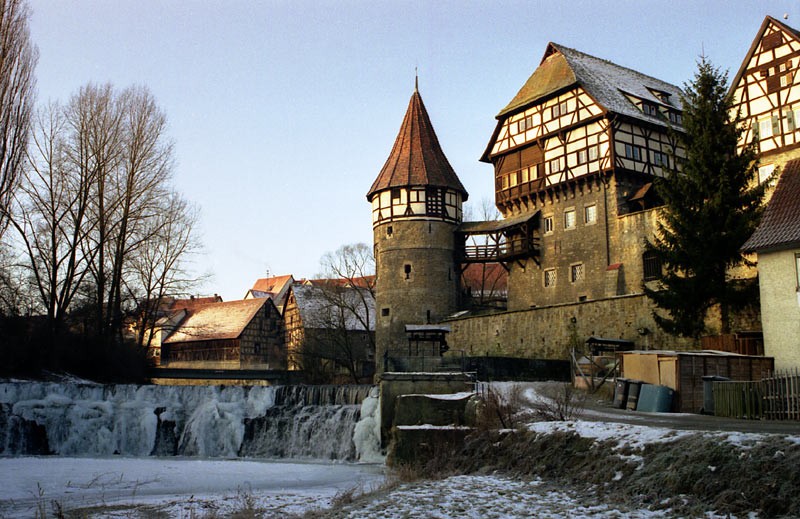 I've been trying to stay busy this summer. One thing I've found time to do is get my DNA tested through Ancestry.com. I knew that I was Swedish, Irish, maybe Scottish, probably English. I even thought I was Norman French at one point. From the research I'd done on my paternal last name, Ballinger, I'd found that it had originated in Normandy under the rule of William the Conqueror. I was shocked when the results of my test came back to me. The largest percentage of my DNA turns up 44% percent German. As it turns out, Ballinger has its own German meaning and pronunciation. I have a map that goes with my results, showing the cities where I have DNA matches. A point of exit from Germany stemmed from Balingen, the town from which my ancestors took their surname before sailing to Pennsylvania, New York, and New Jersey in the early 1700s. Balingen is picture above. Seeing its Google images reminds me of the movie In Bruges, quaint and fairy tale-like. I'm sure it didn't seem this way for my ancestors, attempting to flee centuries of religious war and famine. From the 1700s, I have ancestral links to the cities of Hamburg, Hanover, Kassel, Dresden, Mannheim, Frankfurt, and Heilbronn, just to name a few.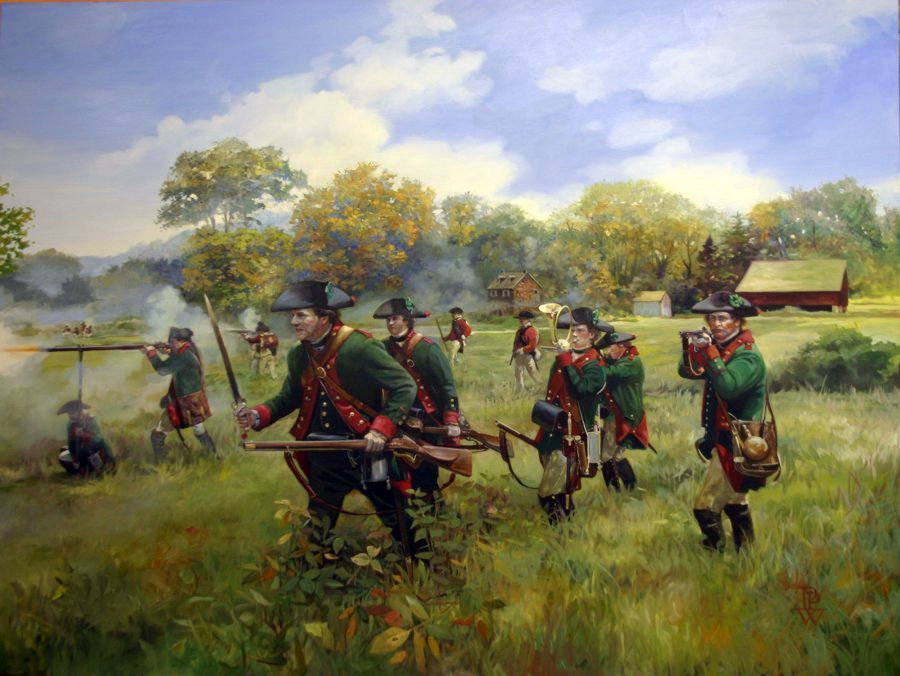

 The second largest chunk of my DNA is 40% Great Britain (England, Scotland, Wales). Those ancestors also started coming over in the early 1700s, from English cities like Manchester, Liverpool, Lichfield, Leichester, Wolverhampton, and Birmingham, Scottish cities like Glasgow, Edinburgh, Aberdeen, and Inverness, and Welsh cities like Ysbyty Ystwyth, Ystrad Meurig, and Ystrad Fflur. Though they speak English now, Wales maintains its Celtic roots in its city names. All the names are in Welsh, a language very similar to highly non-phonetic Gaelic. As for England, I now live in Birmingham, AL, a city created to mimic the steel city of Birmingham, England, where I have heavy ancestral roots. Most of the 40% is between England and Scotland. Scotland also shares with my 7% DNA reading of Ireland and Scotland - which tells that besides my DNA showing up in Dublin, most of that 7% percent is Scots-Irish. The Scots-Irish, a Protestant mix of Irish and Scottish, departed from Belfast in Northern Ireland. My maternal grandmother's surname was McDonald. This is the Irish spelling (as opposed to the Scottish one, MacDonald), though I'm sure lots of the Scots-Irish had Irish surnames. She used to sing the lullabies "Danny Boy" and "Loch Loman," which are respectively Irish and Scottish ballads. It makes sense that she was Scots-Irish, seeing as how she fervently sang both. The picture above is the flag of Northern Ireland.
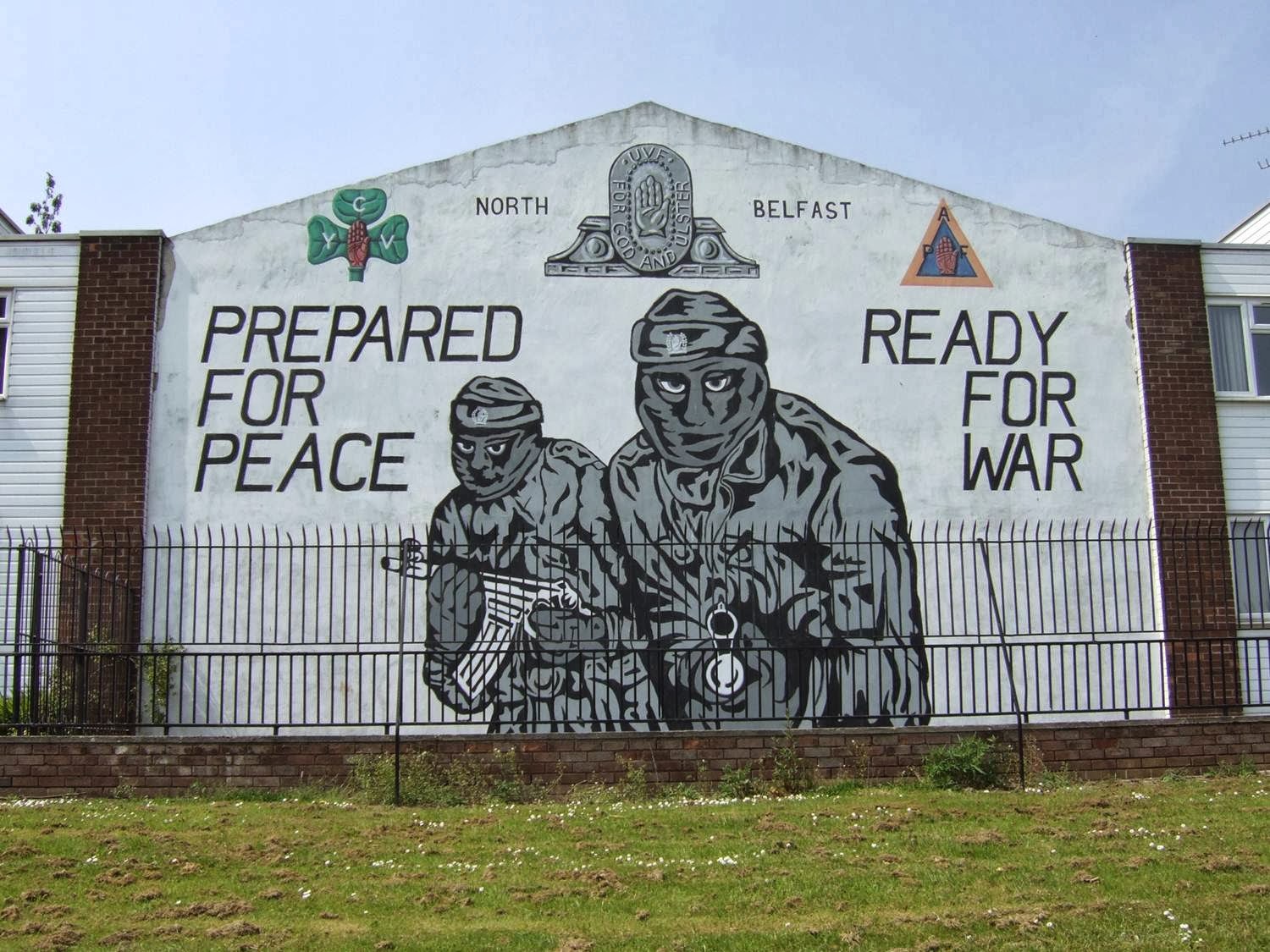 As for the Irish side, this is certainly from my maternal grandfather, whose surname was Kirven. The name originated in Kilkenny, west of Dublin. A Kirven, which means crow in Latin, married a McDonald from Ulster, or Northern Ireland, which is an interesting development. I have long been fascinated with "The Troubles," an ongoing conflict in the 20th century that pitted Northern Ireland against the Republic of Ireland in the south. The Catholic IRA (Irish Republican Army) was created to keep out the British from occupying Northern Ireland, whose residents were seen as loyalists to the British crown. The IRA fought countless skirmishes with the British army and UVA (Ulster Volunteer Forces). Their bloodshed cost many lives, including innocent people caught in the crossfire. I have several books on the conflict. My English and Irish ancestors came over long before the 20th century, but the southern and northern Irish roots in my bloodline make for an interesting development.
 Here I am thinking I'm a descendant of Vikings (which I still may be). It turns out I'm only 6% Scandinavian (Sweden, Norway, Denmark). My Swedish roots, the ones I get from my maternal grandfather's side, are the ones I know the most about. My family tree consists of a slew of Bostroms, Samuelssons, Olofssons, Persdotters, and Svensdotters (dotter, meaning daughter). Unfortunately, not enough of my Swedish relatives have had their DNA tested. On my DNA map, Scandinavia is circled, though there are no cities highlighted to pinpoint my DNA activity. But apparently, my Swedish ancestors shared blood with Norwegians and Danish people, as the map shows all of Scandinavia, not just Sweden. My grandfather's grandfather, Otto Samuelsson Bostrom, immigrated from Backebo, Sweden to Virginia. Backebo is on the eastern coastline of the country, just under Stockholm and just a short distance across the Baltic Sea from Finland. My Scandinavian DNA map intersects with the west coast of Finland, which tells me some of my Swedish ancestors made their way to the Finnish city of Vaasa as well.
 My smallest percentage of DNA, 3 % to be exact, comes from Finland and Northwest Russia. On my DNA map, Finland and Russia intersect with the coast of northern Sweden. Though it is very close to Scandinavia, Finland is not a Scandinavian country. Finland, like Russia, is a Slavic country. It shares linguistic and alphabetical similarities with Russia. Interestingly enough, Sweden has a little-known history with Russia. In the 800s CE, Vikings from Norway and Denmark made their way toward England, Scotland, and Ireland. The Vikings of Sweden, or the Rus, on the other hand, sailed into Russia along the Volga River. There, they traded with the disorganized Slavic tribes who eventually asked the Rus and their chieftain, Rurik, to provide them leadership. The Rus established several cities in the area, including Kiev, in what is now Ukraine. The country of Russia and Belarus are named after the Rus. Scandinavia intersects on my DNA map with not only Finland, but northwest Russia and the Volga River. It makes me wonder, though I can't confirm it, if I'm descended from the Rus. Above is a fun, informational video that I show my students on the history of Russia. To the right is a statue of Rurik in Novgorod.
 If I were to refer to myself as one particular ethnicity, it would be Germanic. Germans, Scandinavians, the Dutch (Netherlands), and the English are share cultural and linguistic similarities. Prior to the 1700s, which the DNA map does not account for, Germany, the Netherlands, and England were made up of barbarian tribes; respectively, the Goths (Visigoths and Ostrogoths) and the Anglo-Saxons. Scandinavia had its own tribes in the Norse. Latin gave birth to Italian, French, Spanish, Portuguese, and Romanian. Old English, which was spoken by the Anglo-Saxons who occupied Britain, was a West Germanic language. It more resembled what the Goths of Germany spoke, which was actually closer to modern German than what the English now speak. The Goths and the Anglo-Saxons shared linguistic similarities, which makes those tribes Germanic. Below is a map that shows all of the areas inhabited by Germanic peoples, including Scandinavia. It's nearly a mirror image of my DNA map.